Pages

Saturday, September 1, 2018

Top Brazilian court bars Lula da Silva from running again for president

Four of seven justices from the Supreme Electoral Tribunal in Brasilia ruled that Lula was ineligible to run in October, while one voted in favor.
Two judges had not yet cast their votes in a hearing stretching late into Friday night.
Universally known as Lula, Lula da Silva is a founding member of Brazil's only socialist political party, Partido dos Trabalhadores (PT), the Workers' Party.
A former metalworker and union leader, he rose through the political ranks to serve two terms as president between 2003 and 2011. He left office with a 90% approval rating, after his policies helped to lift millions of Brazilians out of poverty.
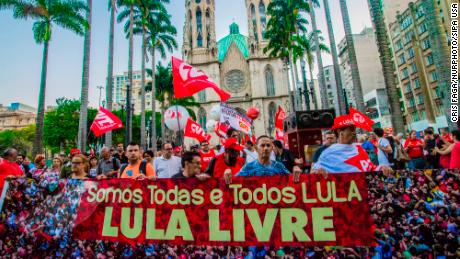
Brazilian lawmakers request name change in support of Lula
But he has been in jail since April after he was sentenced to 12 years for corruption and money laundering. The accusations against him emerged after he left office in 2011.
The 72-year-old has strongly denied any wrongdoing. His defense said he was a victim of political persecution.
Lula da Silva's lawyers can appeal the latest court decision.
Lula da Silva has been in prison since he surrendered to federal police in April. Since then, PT politicians and supporters have held rallies calling for his release and claiming his innocence.
He was registered as the PT's candidate in the upcoming vote in August.
At the time, he said in a statement on his official website that he had submitted his candidacy "with the certainty that I can do much to take Brazil out of one of the worst crises in history."
He also accused political opponents of convicting him without evidence in an attempt to take him out of the election.
Lula Da Silva delivers a speech during the Workers Party National Congress to elect its new president in Brasilia in June 2017.
His conviction stemmed from a wide-ranging corruption investigation into the state-run oil company Petrobras, dubbed "Operation Car Wash."
Lula da Silva was accused of benefiting from the renovation of a triplex in a beach town near Sao Paulo by the construction company OAS. The charges were connected to 3.7 million reais' worth of bribes ($1.1 million) received from OAS through the beachfront apartment. In return, Lula da Silva helped the builder acquire contracts from the oil company, prosecutors charged.
Lula da Silva was initially found guilty of the charges in July 2017.
In January, an appeals court unanimously upheld the corruption and money laundering charges against him, and he was handed the prison sentence.
He was first questioned by police about the corruption allegations in March 2016. Lula da Silva's wife, Marisa Leticia Lula da Silva, who died in February 2017, and six others also were charged.
Born into a working class family, Lula da Silva left school and began working at age 12. Unhappy with the lack of political representation of the working class in Brazil, he decided to get involved in politics and helped found the Workers' Party in 1980.
He was friends with the late Cuban leader Fidel Castro, who supported his political career, and attended Castro's funeral in 2016.

Let's block ads! (Why?)

from CNN.com - RSS Channel https://ift.tt/2C62FEL

Welcome back to Brexitland

Between now and early January at the latest, a deal needs to be struck on Brexit between the UK and the European Union which ties up all the loose ends after Britain walks away from 40 years of membership.
In addition, the groundwork needs to be laid in defining what the relationship will look like in the future.
So, what agreements have been reached, and what remains to be done?
When it comes to the "divorce," many -- if not most -- of the outstanding issues have been settled. The UK has agreed to pay a generous "divorce bill" and both sides have agreed to settle the status of their respective citizens in each other's territory.
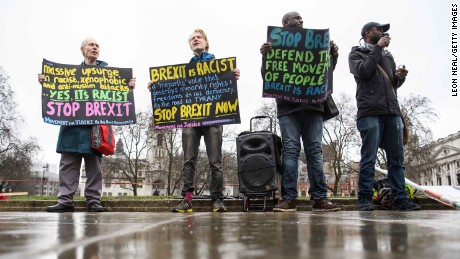
Protesters demonstrate against Brexit in Parliament Square in February 2017 in London.
The main outstanding issue, the one that must be causing negotiators to lose sleep at night, remains Northern Ireland -- or, more precisely, the question of what to do once Britain leaves the EU to avert the need for a customs and regulatory border between it and the Republic of Ireland to the south: an EU member state.
Theresa May says no-deal Brexit 'wouldn't be end of the world'
Which brings us back to our returning (and doubtless well-tanned) parliamentarians. At some point over the next few months, they will be asked to vote on whatever deal the government strikes with the EU.
The European Union has stated repeatedly that the choices on the table are limited. Either Britain remains within the EU's single market, or it leaves it altogether. Similarly, the UK either remains in the customs union, or it faces the imposition of tariffs and other impediments on trade.
So Britain faces a choice. It might decide to remain very closely linked to the EU -- part of its market and customs union and therefore still subject to EU laws (over which, as a non-member, it will no longer have any say) and bound to accept the right of EU citizens to come here and work. Or, we can have a more distant relationship -- a "cleaner Brexit" in the jargon, and leave the single market and customs union.
The problem is that, in the latter case, the EU will insist on a different status for Northern Ireland, keeping it more closely tied to the EU than the rest of the UK so as to avoid the imposition of a north-south border on the island.
And here's the rub. As things stand, it is hard to see there being a majority in the British Parliament for either of these outcomes.
Many MPs would view the former option as a betrayal of those who voted leave precisely to escape from EU law and end the freedom of movement of workers. Meanwhile, not only are less EU-hostile MPs wary of the economic costs of a cleaner break, but the British parliament is unlikely in the extreme to vote for an outcome that will separate part of the country from the rest of it with a customs and regulatory border.
Brexit is a boring, slow-motion train wreck
So as the endgame approaches, and despite the progress made, an obvious achievable outcome is as hard to imagine as ever.
Of course, a lot can change. Such is the febrile state of British politics that it is virtually impossible to predict how our parliamentarians will vote in a vote that will not be held for some months.
And of course, the EU position might change. The sharp rise in the pound following what appeared to some to be positive comments about Brexit ambitions from the EU's chief negotiator underlined what a game changer such a shift would represent.
Unfortunately, that was largely all the incident represented, as Michel Barnier's comments were somewhat misinterpreted and did not imply the kind of softening in the EU's approach that many in Britain assumed (or, rather, hoped, they did).
So there is still much to play for. It is as hard to predict the eventual shape of the Brexit outcome as it ever has been. All we can be sure of is that it will continue to be the single most important issue in our politics for the foreseeable future, dominating governmental and parliamentary agendas, and continuing to feed the anger and bitterness that continue to bedevil our political debates.

Let's block ads! (Why?)

from CNN.com - RSS Channel https://ift.tt/2Q0pWuK