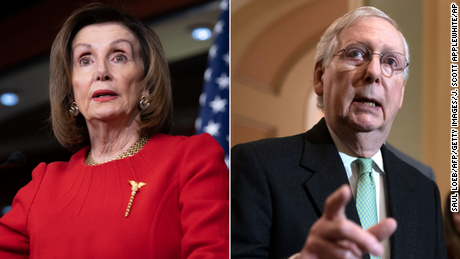
Yet despite this, GOP Senate majority leader Mitch McConnell has refused to commit to allowing any witnesses to be called in the expected upcoming impeachment trial of Donald Trump until after he hears the opening statements from the House managers who are prosecuting Trump and the President's defense team. Worse, GOP Sen. Marco Rubio has declared that he's opposed to calling any witnesses under any scenario because in his view, the Senate should only consider evidence gathered to date by the House. And President Donald Trump on Sunday tweeted that he supported an "outright dismissal" of the articles of impeachment by the Senate instead of a trial, which would suggest that he now favors no witnesses being called either.
Why wouldn't senators who are acting as jurors want to hear all the evidence? A presidential impeachment trial in the Senate without witnesses would be without precedent. In the first such Senate trials in our nation's history, involving President Andrew Johnson in 1868, 41 witnesses were called: 25 by the prosecution and 16 by the defense.
And in President Bill Clinton's 1999 impeachment trial, three witnesses were called to testify: Monica Lewinsky, Clinton confidant Vernon Jordan and White House aide Sidney Blumenthal. These witnesses all sat for videotaped depositions conducted by the House managers and then relevant portions as determined by the Senate were played for the senators.
All this occurred after an exhaustive investigation by special counsel Kenneth Starr that began in 1994 and lasted until he delivered his voluminous report in 1998. During that four-year period, Starr was able to question under oath every witness he wanted from Clinton's close aides to even President Bill Clinton himself.
In contrast, in Trump's case, the President directed certain key witnesses "not to comply," with subpoenas, including his chief of staff Mick Mulvaney, as the articles of impeachment approved by the full House set forth. Thus, thanks to Trump's alleged obstruction, there's still vitally important information the Senate needs to gather surrounding the charges in the articles of impeachment that, "Trump solicited the interference of a foreign government, Ukraine, in the 2020 United States presidential election ... in pursuit of personal political benefit."
Regarding Rubio's contention about fact-finding beyond that conducted by the House, the 1986 Senate rules for impeachment trials that are still in effect today provide that the Senate has the power to form a committee of Senators to, in essence, continue an investigation begun in the House. Section XI of these rules provides that the Senate shall have the power to "appoint a committee of senators to receive evidence and take testimony at such times and places as the committee may determine."
For example, the Senate employed that Senate rule for three recent impeachment trials of federal judges. In 1986 the body called 21 witnesses as part of the impeachment trial of federal district Judge Harry E. Claiborne, and in 1989 for the trial of federal Judge Alcee L. Hastings, the Senate committee took the testimony of 55 witnesses. And in 2010, the most recent impeachment trial in the Senate, 26 witnesses testified in connection with the case of federal Judge Thomas Porteous.

But now in the case of the President of the United States, Republican senator leaders refuse to commit to calling even one witness.
Democratic Senate leader Chuck Schumer has only requested four witnesses to testify in the trial, not 21 or 55. And one of those four, Trump's former national security advisor John Bolton, has recently agreed to testify in the trial if subpoenaed by the Senate. (Trump has suggested he would try to block Bolton from testifying on the grounds of executive privilege.)
The need to hear from witnesses at the trial is made even more acute given that the entire process already been tainted by McConnell and GOP Senator Lindsey Graham who have declared in advance that they will not be impartial jurors. Graham recently admitted, "I'm not trying to pretend to be a fair juror here." McConnell, who has told us in the past he's working in "total coordination" with the Trump White House on the Senate trial, recently stated about the trial, "I'm not impartial about this at all."
These statements seemingly make it impossible for these two Republicans to take the oath required of all Senators before a Senate impeachment trial begins that provides they swear to "do impartial justice according to the Constitution and laws." Given their past comments, would McConnell and Graham be knowingly and willfully making false statements to Congress if they take this oath?
Since the GOP controls the Senate, it's their call if the upcoming proceedings to decide whether Trump should be the first President ever removed from office will either be an actual trial as mandated by the US Constitution or partisan show designed by the GOP to protect Trump. America is watching for their choice.

No comments:
Post a Comment